SCF
NACF member profile – Q&A with Kingsley Clarke, Head of SCF (South West)
- How would you describe Southern Construction Framework?
SCF is a leading public sector procurement framework for London, the South East, and the South West, established as a partnership between Devon and Hampshire.
We work with clients across a range of sectors, including, Local Authorities, higher education, healthcare, leisure, and defence, to provide end to end support on public sector construction projects. In practice, this means ensuring the procurement process is as effective as it can be through early engagement and collaborative working – modelled on ‘Two Stage Open book’ procurement. Of course, it also means our continued involvement and support post procurement.
It has delivered in excess of £9 billion worth of combined construction schemes, helping clients to deliver in excess of £500m building work every year since it began in 2006.
- What was your journey into your role as chair for NACF?
My journey to becoming Chair of NACF has been a natural extension of the work I’ve been involved in through SCF for many years. SCF was a founding member of NACF, so I’ve seen first‑hand the value the association brings in giving the public sector a strong, collective voice around framework delivery, procurement, and best practice.
Through my role leading SCF Frameworks in the South West, I’ve worked closely with local authorities and public sector partners on some of the real challenges facing the industry from skills shortages and capacity pressures to the need for more sustainable, value‑led delivery. NACF plays a crucial role in feeding those frontline experiences into important conversations and knowledge sharing across frameworks.
When the opportunity came up to take on the chair role, it felt like the right moment to step forward and help guide the organisation into its next phase. I’m keen to build on the strong foundations laid by John Simons and Keith Heard, and to continue demonstrating the power of construction frameworks that are designed by the public sector, for the public sector.
- What are your most innovative public sector builds and what makes them special?
It’s difficult to single out just one project, as every scheme delivered through SCF brings its own form of innovation, whether that’s in sustainability, procurement, or community impact. One standout example is St Sidwell’s Point Leisure Centre in Exeter, the UK’s first Passivhaus‑certified leisure centre.
What makes it particularly special is that it redefines what’s possible for highly energy‑intensive public buildings, delivering around 70% energy savings compared to a typical leisure facility. Innovation extended beyond design into delivery, with a strong collaborative approach and initiatives like the Passivhaus Passport, which upskilled the supply chain and embedded quality across the project. The result is a future‑ready, low‑carbon public asset that demonstrates how the right framework approach can unlock ambitious, value‑led outcomes
- What Makes You Proud to Be Part of the South West?
What makes me proud to be part of the South West is the strength of collaboration and shared purpose across the region. There’s a real willingness here for public sector organisations, contractors and communities to work together to do things better not just faster or cheaper, but in a way that delivers long‑term value.
The South West consistently punches above its weight when it comes to innovation in sustainability, placemaking and public value, whether that’s leading on net zero, future‑ready buildings or community‑focused regeneration. There’s also a strong sense of regional identity and pride, which translates into projects that genuinely respond to local needs rather than one‑size‑fits‑all solutions.
There are so many examples of this I see day to day, but I’m also fortunate enough to chair CESW and through this one of the clubs spurred by a conversation at an Exeter Leadership Dinner led to the production of a white paper, Particular kudos to Tanya Loosemore, Nigel Whelan and Matt Couzins for this.
Being part of that and helping to support public sector clients to turn ambition into delivery is something I’m genuinely proud of.
- What do you do to support local communities?
Social value is integral to our processes and operations. We are committed to delivering social outcomes through our projects across the South of England. An integral part of our mission is to achieve long term legacies through the built environment. SCF was also a founding member of the region’s shared apprenticeship scheme which aims at boosting skills in the construction sector, something which is vital at a time of chronic skills shortages.
- How Did You First Become Involved with the NACF?
My involvement with NACF came through SCF’s role as a founder member of the association. From the outset, I was closely involved in conversations around how frameworks could work more collaboratively, share best practice and better support public sector clients. Over time, that involvement deepened through regular engagement with NACF members, contributing insight from live projects and seeing first‑hand the value of having a strong collective voice for framework providers.
- Why Is the NACF Important in the Construction Industry?
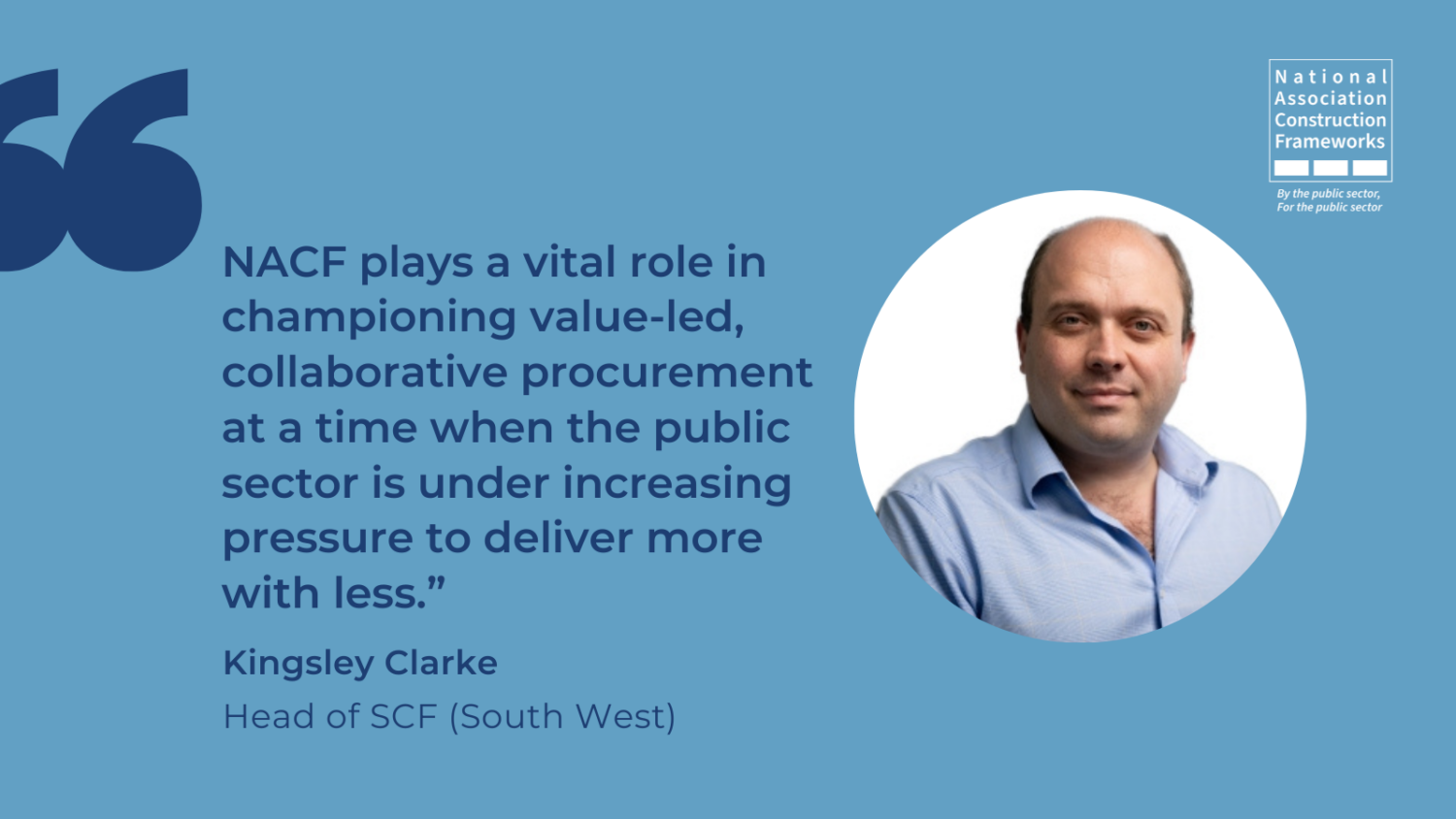
NACF plays a vital role in championing value‑led, collaborative procurement at a time when the public sector is under increasing pressure to deliver more with less. It provides a trusted forum where framework providers can share insight, raise standards and feed real‑world experience into national policy discussions.
Importantly, NACF helps ensure frameworks are understood not just as procurement routes, but as strategic enablers supporting better outcomes on sustainability, skills, social value and long‑term performance across the construction industry.
Ultimately NACF is made up of Frameworks (predominantly regionally led) but all under direct control of Local Authorities making us truly by the public sector and for the public sector. There is certainly no other similar collective in the Construction Sector and to our knowledge any sector (if we are wrong let us know we’d love to chat!!)
- What Would Be Your Best Piece of Advice for a Public Sector Organisation Considering Using a Framework?
My advice would be to engage early (By that we mean before starting RIBA 3) and be clear about your outcomes, not just your outputs. A good framework should help you shape your project from the earliest stages whether that’s around carbon targets, community impact, skills or long‑term value not simply appoint a contractor. Of course, they will also work with your budget and time requirements aswell!
It’s also important to see frameworks as partnerships, not transactions. The most successful projects are those where clients make full use of the expertise, market insight and collaborative culture that a well‑run framework can offer.